Holding without power
The physics before the problem-solving
Once food is cooked, the clock starts. Without a mains outlet — which describes almost every tailgate lot — keeping food at a safe serving temperature is a materials problem, not a cooking one. The material in question is mass.
Heat stored in a large volume bleeds away more slowly than heat stored in a small one. A full Dutch oven retains temperature far longer than a half-empty one, because there is more hot matter for the ambient air to overcome. This is not a trick; it is physics. Every practical holding technique is an application of the same principle: maximize the thermal mass around the food, minimize the surface area exposed to cooler air, and slow convective loss by sealing the container.
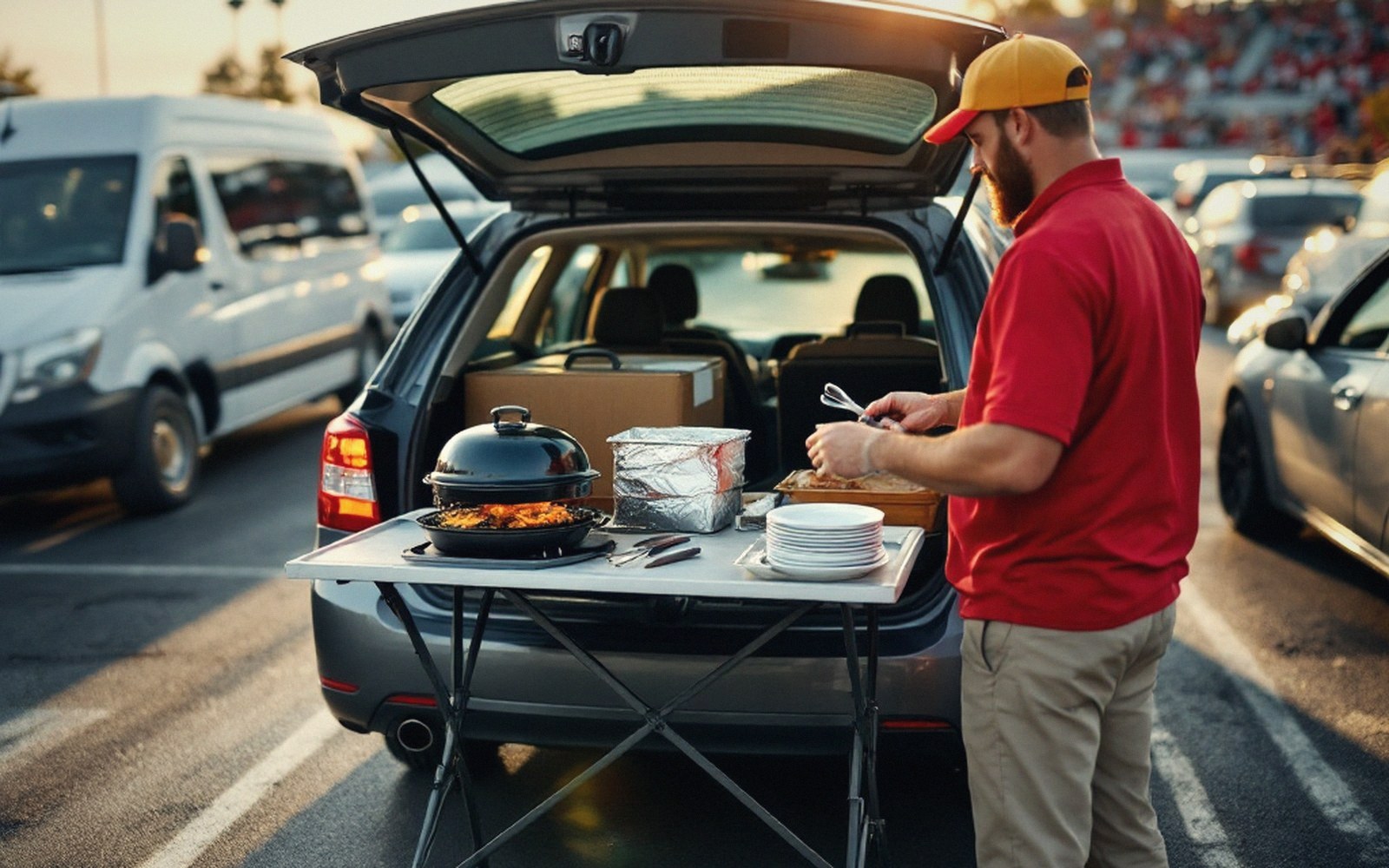
The corollary matters equally. Food safety guidance draws a clear line at 140 °F (60 °C) as the minimum holding temperature for cooked food. Below that, and the two-hour rule — aggregate time in the danger zone, 40–140 °F — begins to count down. Your job in the lot is to stay above that line without any electricity to help you.
The tools: insulated boxes, towels and bricks
The workhorse is a dry cooler or insulated bag repurposed as a hot box. The same insulation that slows the ingress of heat on the cold side slows its egress on the hot side. Line the bottom with a folded towel — fabric is a poor conductor and cushions the vessel — nestle the covered pot or pan inside, pack more towels around the sides and lid, and close the cooler. A pot of chili or a tray of pulled meat held this way will stay above safe temperature for two to three hours, sometimes longer if the vessel was screaming hot when it went in and the cooler was pre-warmed.
Pre-warming is easy and often skipped. Boiling water poured into a cooler for ten minutes, then tipped out just before the food goes in, removes the cold thermal mass the cooler shell would otherwise steal from your dish. That ten minutes pays back at least twenty or thirty minutes of holding time at the far end of the day.
The numbers that matter
- 140 °F (60 °C) minimum safe holding temperature for cooked food
- 40–140 °F the danger zone; two-hour aggregate limit applies here
- 10 minutes how long to pre-warm a cooler with boiling water before the food goes in
- 30 minutes minimum time to heat a firebrick on a grill to useful thermal mass
- 2–4 hours realistic holding window for a well-packed hot box, conditions-dependent
Bricks — or any dense, non-porous object — extend the technique. A firebrick heated on the grill for half an hour stores a surprising quantity of heat. Set it in the bottom of the hot box before the pot, and it becomes a passive heat source. The food is no longer cooling from the moment it leaves the flame; instead it has a reservoir to draw from. Foil-wrapped rocks work on the same principle. Terracotta, soapstone and cast iron all hold heat well; hollow materials and anything that can crack under thermal stress do not belong in this application.
For foods served in the vessel — soups, stews, braises — keep the lid on until serving. Every time the lid comes off, a spike of steam escapes and the temperature drops measurably. Serve with a ladle deep enough to reach the bottom, replacing the lid between portions.
Managing the last hour
Holding is not indefinite, and the practical limit for most setups is three to four hours from the end of cooking to the last serving. Plan the cook so the food finishes as close to peak serving time as possible, rather than early to give yourself comfort. If you are cooking for a crowd of twenty, you want a pot that comes off the heat about forty minutes before the hungry wave arrives, not two hours before.
When the lot empties and the walk to the stadium begins, food that has been held for more than two hours in uncertain conditions goes in the bin. Not back in the cooler, not left on the table — binned. The rule is conventional because the alternative is guesswork about temperatures nobody measured, and guesswork has a poor record at this particular job.
What holds heat and what does not
- Dense, non-porous materials (firebrick, cast iron, soapstone, terracotta) — good heat reservoirs
- Hollow or air-filled materials — poor; lose heat quickly
- Anything that can crack under rapid heating — exclude from the hot-box entirely
Mass and insulation buy you time. They do not buy you indefinitely.