Serve from one long side
One decision about table orientation eliminates most of the crowding that makes an outdoor spread miserable to manage.
The geometry of a food table
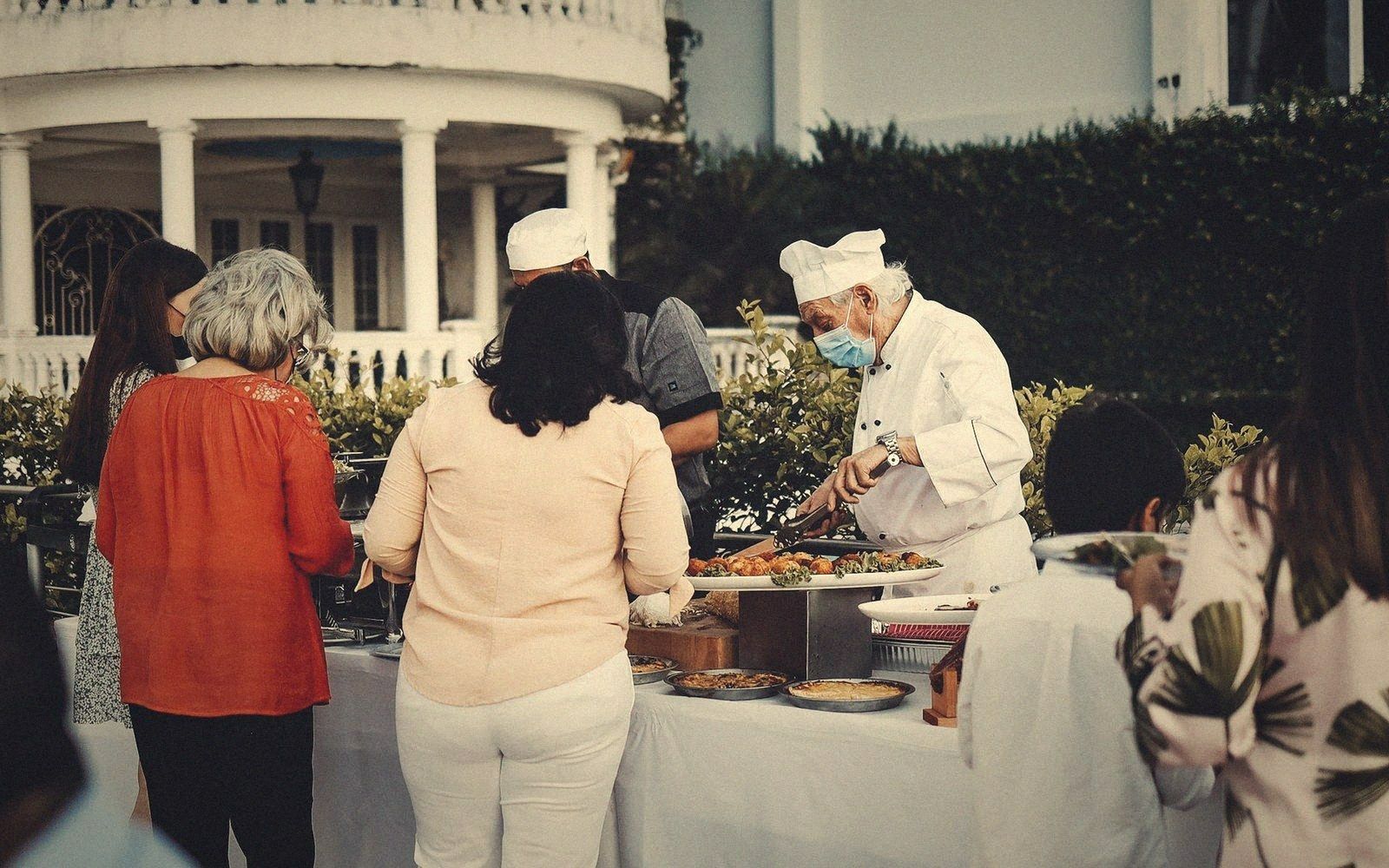
A rectangular folding table has two long sides and two short ends. In a crowded lot, how people approach it determines whether service flows or stalls. Open a table to access from all four sides and you have created something that looks generous but functions as a scrum: people reach across each other, block the path of the person next to them, and linger at odd angles while others wait. The geometry encourages collision rather than movement.
The fix is simple and costs nothing: place the table with one long side against a barrier — the side of a vehicle, a row of coolers, a run of canopy legs weighted with chairs — and serve exclusively from the other long side. Suddenly there is a direction. People approach, move along the table, and leave. A single file becomes possible. A natural start and end appear without any instruction from the host.
How traffic actually moves
Once you have committed one long side to service, the short ends become your control points. Put nothing at either end that people need — no napkins, no utensils, no drinks. If something useful sits at the far end, people will wade past the whole queue to reach it, defeating the line before it forms. Napkins and cutlery go at the point where the queue begins, ideally before the food, so people have hands ready by the time they reach anything to eat.
Drinks belong somewhere else entirely. A second cooler kept away from the food pulls drink traffic clear of the food table; if beverages are nested among the serving dishes, people will stop dead in the middle of the line to dig for ice and the queue compresses behind them. Even moving the drinks cooler two metres to the side — parallel to the table but not adjacent to it — separates the two traffic streams and reduces dwell time at each dramatically.
The spatial logic
- One long side against a barrier vehicle flank, cooler row, or canopy leg — closes the back and creates a single service face
- Short ends: no useful items placed there they become the start and exit of the line, not destinations
- Napkins and cutlery at the queue entry point, before the food; condiments at the exit end
- Drinks separated from the food table entirely even two metres of lateral distance breaks the traffic streams
The same principle applies to condiments. Do not run them down the centre of the table interspersed with the food. Group them at one end — the exit end, not the entrance — so people who want them step forward after collecting their food rather than reaching back across the next person.
Depth and reach
A folding table's surface is typically around sixty centimetres deep. Anything placed at the far edge of that table requires a full-arm reach, which means leaning, which means blocking. Keep serving vessels in the front half of the table surface — the half facing the queue. The back half is for lids, reserves and utensils waiting to replace the ones in use. Food that refills from the back stays hot longer in transit, and the person restocking reaches into their working space without crossing the serving plane.
If you have more food than front-half space permits, consider staging. Run a second table perpendicular to the first to create an L-shape, with its own single-sided service face. Two short queues at an L are almost always faster than one long one at a single overcrowded table, and the configuration lets you separate hot food from cold without compromising either.
Making it legible without signs
People read a table by what is closest to them. They pick up a plate at the near end, move right or left, and stop at whatever interests them. The sequence you choose for your dishes is the sequence in which people encounter them, so it matters: lighter items and bread at the start fill plates gently and slow the pace just enough for people behind to spread out; the main protein, which takes longest to serve and causes the most traffic to bunch, goes in the middle where there is room to pause; mess-prone sides — anything wet, crumbled or requiring assembly — toward the exit, where a person has space to handle them without the queue pressing from behind.
None of this requires rope lines or a hand-lettered plan tacked to the canopy. A table arranged this way teaches the queue what to do. People follow a direction when one exists; the trouble is that most outdoor spreads never establish one, then wonder why service stalls. One long side, one direction of travel, and condiments at the exit. That is the whole system.
Dish sequence down the table
- Bread and lighter items first — fills plates gently, lets the queue spread
- Main protein in the middle — most dwell time, needs central space to absorb it
- Wet or assembly-required sides at the exit end — room to handle them without blocking the queue behind